
In the past, Enterprise Resource Planning (ERP) systems were primarily meant to handle the complexity and were created as a single digital roof. That would have finance, supply chain, human resources, and operations, among others. The focus was on functionality and performance, and user experience (UX) was secondary. However, currently, the workers demand easy interfaces and online processes similar to consumer applications. It is obvious that UX is not a luxury feature of ERP systems anymore.
Functionality to Usability:
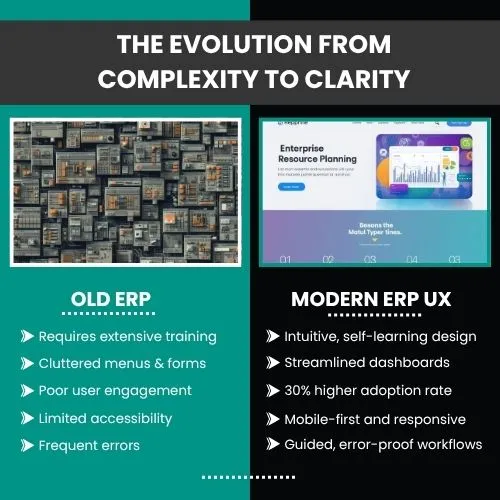
The shift in ERP analytical purposes The conventional ERP systems had been regarded as being extremely complicated. They needed to undergo a significant amount of training, tedious onboarding and some amount of technical knowledge. That was how it had cost decades to do business. However, with the shift to the digital workplace, the expectations shifted. Current users, especially the younger generation of professionals, use other elegant and simple-to-use systems such as Google Workspace, Slack, or Asana on a daily basis. Given the clunky ERP interface that is stifling, the users will be frustrated, distracted and even less productive.
Why UX Matters in ERP Systems
1. Better User Adoption
Adoption is among the leading problems faced during the implementation of ERP. A powerful system is not effective when there are employees who are unwilling to utilise it. A friendly and easy-to-use system will motivate participation and reduce opposition to change. When the performance of the task did not pose any problem and the system carried out its response as a result of the natural order of navigation, there are chances that the employees will accept it as part of their lives.
2. Improved User Experience, Significant Hike in User Adoption.
Studies have found that a system that has been well-designed in terms of UX design can see up to a 30 per cent boost in its user adoption rate. This can either spell out the difference between success and failure of an ERP project.
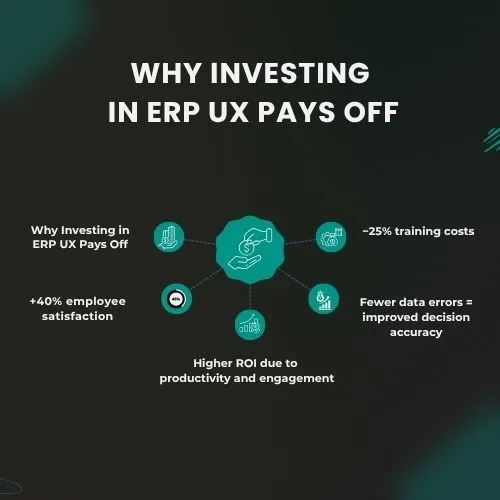
3. Reducing the training and support expenditure.
Enterprise resource planning is training that is quite costly and time-consuming. Conversely, when UX is prioritised, employees will not be required to be informed on how to use the system. They will learn to do so naturally by themselves.
The user-friendly dashboard layouts, easy-to-read graphics and informative tooltips. Do not just enable the employees to discover where the various data are; they also enable the employees to devote more time towards their actual tasks. This means that besides formal training, companies save on other costs that would otherwise consume IT resources through support requests.
4. More Efficiency and Fast Decisions.
The concept of UX has been misconstrued, as the UX is about the look and feel. In fact, it is more about the usage of the system to the maximum benefit. ERP interfaces are designed well to eliminate the mundane processes. Ensure that the processes that are challenging to complete are executed successfully. And provide the real-time data in the formats that can be consumed easily.
5. Certainty of Fewer Mistakes and Higher Data Quality.
A bad ERP system will cause a larger number of human errors, e.g., wrong data entry, incorrectly chosen menu items or overlooked useful information. The same cannot be said of a user-friendly design; it beckons the utilisation of cognitive resources and in effect charges them successfully; therefore, the user is motivated to feed in appropriate information and follow the standard processes.
Best Modern Design Principles and the Role Which They Play in the ERP UX.
The best contemporary ERP systems are, as much as possible, combined with design thinking, which is a human-centred approach and puts more emphasis on empathy, tests, and iteration as the most essential stages. Key factors are:
• Consistency: There is unification of design items in different modules such that users do not have to go through the system rediscovering its path.
Clarity: The information has not been cluttered much, and the priorities of information have been given priority such that it is easier to get understood.
• Accessibility: A mobile-first strategy is used, and several devices are supported so that employees can be accessed wherever they are working.
• Personalisation: The different user roles have dashboards that only display the corresponding KPIs and workflows.
A Strategic Advantage for UX
Spending on ERP UX design is not an IT decision, or even merely an IT decision; it is a business strategy. Those companies that prioritise usability will realise tremendous productivity, employee satisfaction and overall ROI.
Final Remarks
As the ERP systems continue to change, the user experience has remained one of the primary determinants of success. Therefore, the period of hard-to-use and user-unfriendly software has passed. Firms that consider UX in their product designs do not simply make it easier to work in the firms; they develop flexible, data-driven, and, therefore, future-proofed companies.