Enterprise Resource Planning (ERP) systems have taken centre stage in modern organisations. They house the HR files, customer databases, books of accounts and contracts with suppliers. The fact that information is sensitive and such a concentration is an attacker target point of ERPs. It is an uphill legal and practical responsibility of UK organisations to make sure that they are doing security and data protection right.
The legal basis: UK GDPR and Data Protection Act 2018.
The UK GDPR and the Data Protection Act 2018 apply to you since your ERP activities relate to personal data. These form the famous principles of protection (lawfulness, purpose limitation, data minimisation, accuracy, storage limitation, integrity and anconfidentiality) and responsibility requirements. Which mean that the organisations are to be in a position to demonstrate compliance. Otherwise, it can be under regulatory consequences of the ICO, including fines and enforcement notices.
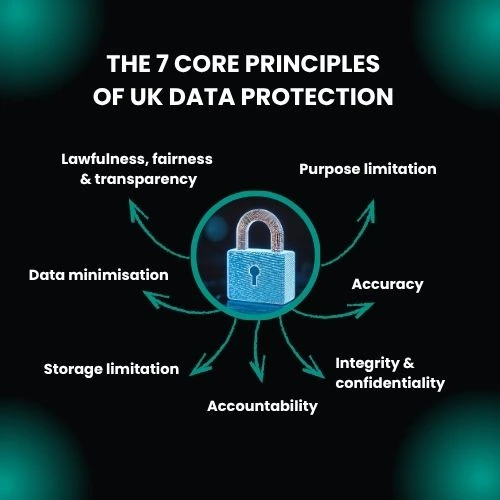
Best practices of ERP projects.
Reduce what you possess and chart data.
The first step is to determine what the identification of the personal information is and the aim of the personal information in every ERP module. The fewer fields you cultivate, the shorter they are, and the less your legal and security liability.
Conduct a high-risk processing DPIA.
A Data Protection Impact Assessment (DPIA) is a legality and good practice in which ERP modifications pose possibly significant risks to individuals. Including the incorporation of biometric HR functionalities, massive profiling or massive disclosure to third parties. DPIAs make you seek and suppress risks before go-live.
Defence in depth: encryption, access controls and logging.
Ensure that confidentiality, integrity and availability are design objectives that are not compromiseable. Keep personal data confidential when it is in transit or during rest; use least-privilege roles, strong authentication and audit logs. These practices are in line with ICO best practices. As well as the advice by NCSC on the security of cloud and supply chain.
Due diligence of suppliers and security of supply chain.
Some ERPs will embrace third-party modules, cloud hosting or integrators. A second recommendation made by NCSC is a principled approach to supply-chain security. Assess the controls of suppliers, contractual security SLAs with demand, and evidence (e.g., penetration tests, certifications). Do not believe that the generic terms of your cloud provider encompass the specific personal-data commitments that your organisation possesses.
Incident and breach reporting.
The regulations in the UK also state that notifiable personal data breaches are to be reported to the ICO in a timely manner, where feasible, within 72 hours of their realisation. In order to fulfil such a deadline, the ERP programme must include an incident response playbook, forensic logging, and templates of communications.
Certification and minimum controls.
Cyber Essentials (or equivalent) certification is an indicator of primitive hygiene and could be a procurement requirement that accrues to a government contract. They can use ISO 27001 or supplier reports such as SOCs to communicate about well-developed security management to provide organisations with more confidence.
Government, education and documentation.
Compliance is not technical but organisational. Assign or involve a Data Protection Officer where applicable and Records of Processing Activities (RoPA), and perform regular personnel training, especially for the application of ERP users; the finance team, HR and procurement teams are generally high-risk users.
Lifecycle management and continuous monitoring.
ERP systems security and data protection are not one-time activities since they are constantly changing as the business operations change. After the system has come online, organisations should ensure that they follow constant monitoring of access patterns, user behaviour and system configurations so as to identify anomalies as early as possible. Quarterly audits or penetration tests are some of the periodic reviews that can be used to make sure that the originally designed controls are still effective against a new threat or regulatory changes.
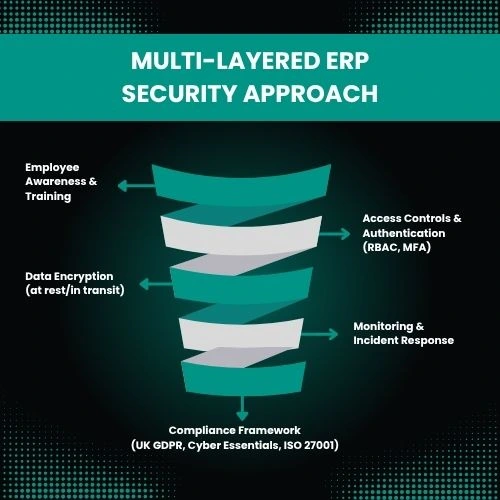
Cultural reinforcement and awareness of the employees.
Human error is one of the most widespread causes of breaches in data despite the presence of strong technical controls. To create the culture of security awareness among the teams utilising ERP. It is important to organise the simulations, refreshers, and policy reminders to make sure that the employees are aware of the consequences of misconduct with the sensitive data. Phishing awareness, secure passwords, and reasonable use of mobile or remote access to ERP should be the focus of the training.
By integrating these steps into day-to-day processes, it is possible to keep ERP compliance not just a project milestone but a long-term organisational strength. Sensitive information protection, customer confidence, and regulatory tranquillity.
Final checklist (quick)
- Data mapping & minimisation
- High-risk processing DPIA.
- Encryption, RBAC, MFA, logging
- Due diligence and contractual SLAs of suppliers.
- Incident response + 72-hour breach procedure.
- Information on Cyber Essentials / ISO 27001 as required.
ERP implementations are major change programmes. Unless security and data protection are taken into account during the initial sprint, they will fail. The design, end-to-end testing, and post-launch governance should include compliance. That is how organisations in the UK reduce the legal risk and keep the sensitive business data in safe places.