


British companies are already under the constant pressure to change the business, to be a company of more recognisable cost, and to make decisions on data in an increasingly competitive market. ERP solutions have made it easier for departments to be transparent and systems to be automated and integrated. The broken promise is due partly to the fact that the cost and complexity of implementing them within organisations is so great. The issue is how organisations can derive a dollar-for-dollar return on their investment in ERP.
The Cost of Implementing ERP
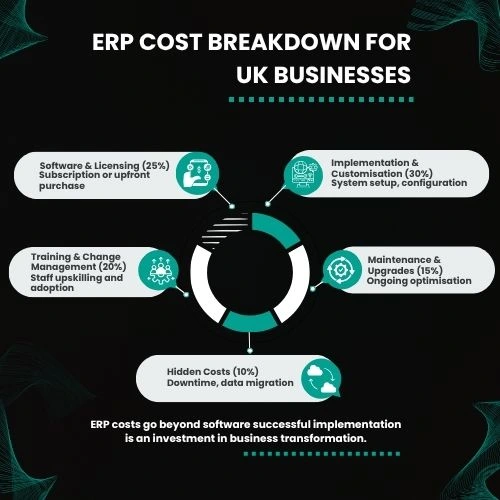
On top of licences, there are the additional costs of service in connection with an ERP project. It is an investment which has layers – a multi-layered investment, one which requires: Software & licences On-premise ERP requires capital-intensive payments of upfront costs of software installation, contrasted with SaaS ERP, where subscription payments are made upfront. , Implementation and customisation: Not all of them have the same workflow capabilities. As well as that, it is a huge effort to set up the system as well as integrate it with your own business operations. , Training, change management: No matter how good the ERP system of choice may be, without the cooperation of the users of the system, there is no way it can work. Product development, market development, supported by product development. And training will ensure that staff reinvent the wheel and resist using the system.
Maintenance and Upgrades
Whether hosted from a local server or the cloud, ERP needs constant maintenance, patching and upgrades to keep it secure and compliant.
The cost of implementing an ERP generally affects something in the region of £50,000 to £500,000 for the typical UK small- to medium-sized business. This, of course, depends on the size and complexity of the project. Large corporations can spend millions. But don’t be too concerned with the cost. What is important is what it will cost your business.
ERP ROI: Not Just Numbers
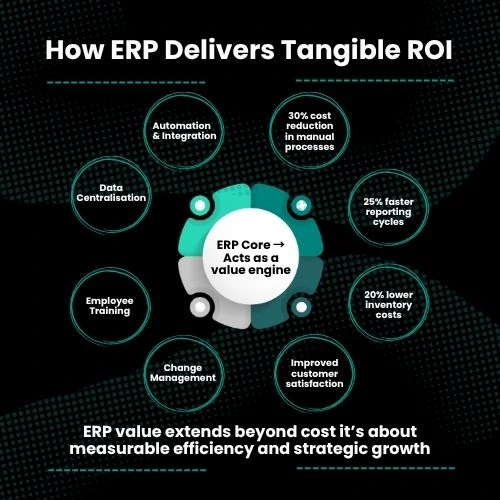
Consider the ROI from the ERP. not just as saving money. It is its effect on the way that you do things that results in better profits. However, before starting to implement, you will need to have set some clear points that define your success. Here are the normal areas where you will have some ROI.
• Less Manual Work: It saves you valuable time and costs of labour by automating the boring, repetitive tasks such as in HR and finance.
• Better Buying and Stock Control: An improved view of your supply chain gives you better waste control and stock-out situations. Having collected all your information in one place allows you to make quicker and more accurate decisions through better forecasting and reports.
• Happy Customers: Better service responses and revenues through CRM and built-in order management.
With the right approach to ERP, you can see a return on investment, ROI, of 150 to 300% in three to five years, depending on how the approach relates to business success.
How to Get More from Your ERP Investment
Getting the most out of the investment in ERP is a function of planning, not of the technology. What should U.K. businesses do to enhance their value?
1. Know What You Want
Know what you define success as before you select a vendor. Will success mean reducing order processing time by 30%? Lowering inventory cost by 20%? Define your goals early, and ensure every rule in software selection and user training helps you achieve them.
2. Choose The Right Partner
The ERP partner will make or break your ERP project. Make it your business to find advisers in your industry who have business minds and know the law. For purposes of U.K. businesses, they should be cognisant of local GAAP and MTD rules.
3. The Change is the Key
ERP changes are changes to the business and not just technology changes. Having the staff involved from the beginning and training them properly with an understanding of the benefits will assist in conversion resistance.
4. Start Simple, Grow Smart.
Focus on what is really important to the business. Don’t try to do everything at once. Take the new system out in bits and pieces so the various functions can learn, improve and adapt before the ultimate rollout. This causes the least friction and problems.
5. Monitor and Evaluate
The return on investment of the system won’t end when it goes live. Be sure to monitor the KPIs that were surveyed against the baseline as well as make adjustments where needed. Continue to enhance the ERP system in order to stay current with ever-changing business needs.
Common Mistakes to Avoid
Most ERP projects will fall short not necessarily because of the tech failure, but due to lack of planning and unrealistic expectations. Be sure to steer clear of the following:
- Calling for an abrupt vendor change without a clear understanding of actual business needs.
- Failing to properly train employees on system usage and best practices.
- Ignoring data quality and failing to plan effectively for data migration.
- Neglecting continuous improvement once the system goes live.
The Bottom Line
Installing an ERP system is a huge step for any organisation. For UK-based businesses operating on limited budgets in an unstable economy with ever-changing laws, an ERP system can lead to growth opportunities in the future or cause them to fall behind.
