With the dynamism of business in the UK, the use of modern Enterprise Resource Planning (ERP) systems promises to provide SMEs with smoother operations, better data insights and competitiveness. However, a large number of UK SMEs are not only hamstrung by technology but also face a massive skills gap between what their workforce can perform and what the current ERP effectively requires. Below, we explain the nature of that gap, its implications, and strategies to overcome it.
What is the digital skills gap amongst UK SMEs?
Studies indicate that the skills gap between UK SMEs is a reality and multi-dimensional:
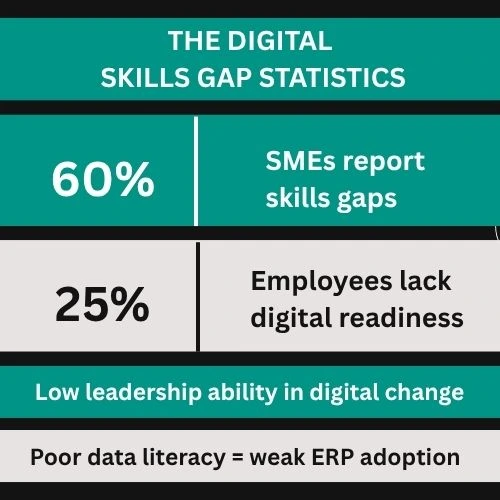
• Approximately three out of five SME employers report having detected skills gaps within their organisations within the last 12 months – especially relating to technology/IT, AI and overall digital skills. Small Business Charter
• More than a quarter of employees believe they have inadequate digital skills to do their current jobs. The majority of organisations do not provide meaningful upskilling. SME Today+1
• Foundational technical knowledge is also deficient: e.g., a lot of SMEs do not know how to use the fundamentals of software (e.g., Microsoft 365), which influences productivity. logisticsit.com+1
• Another difficulty is that a significant portion of SME leaders themselves are ill-equipped to lead the way to digital change. Leadership capabilities to manage tech transformation are low in many cases.
Such shortcomings are particularly worrisome when employing ERP, which often necessitates data literacy, change administration, understanding of procedures, and specialised technical integration expertise.
Why It Matters: The dangers of overlooking the gap in deployments of ERP.
The consequences of not dealing with this skills gap can include:
• Not adopted: Personnel can be reluctant to use new systems, or they start using the same workarounds, which can decrease ROI.
• Underuse: Analytics, automation, integrations, etc. are critical features that may not be utilised at all unless someone can configure them or maintain them.
• Operational interferences: Data migration, reporting or user training or customisation errors may cause delays, errors or cost overruns.
• Failure to leverage competition: Lack of digital prowess means that SMEs could lose competitiveness to more efficient, customer-responsive and innovative competitors.
Actions to Reduce the Gaps in Skills.
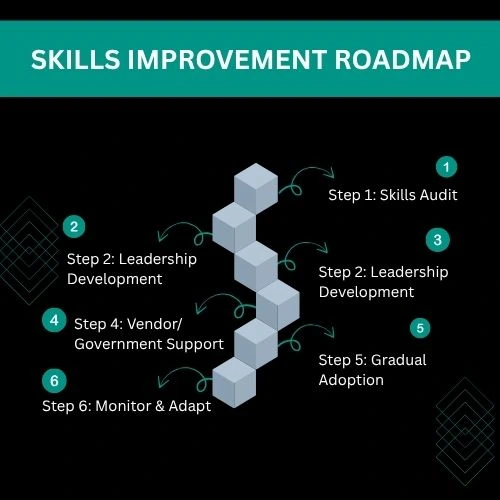
UK SMEs can take the following practical steps to boost their skills in executing a modern ERP system:
1. Begin with a Skills Audit
o Evaluate your existing team: what their strengths are (data handling, system administration, process design, change management) and what areas they are weak in.
o Assign map skills to the ERP rollout plan: implementation, maintenance, customisation, and governance.
2. Develop Leadership and Change Management Ability.
o Make senior leaders realise the strategic importance of ERP. Not only cost savings in the short term, but long-term efficiency and use of data to make decisions.
o Have an internal champion/cross-functional team that will spearhead adoption. Translate business requirements to technical requirements, and may serve as an interface between staff, vendor, and leadership.
3. Invest in Specific Training and Upskilling.
o Technical training: the courses about the certain ERP software, data migration, and user configuration.
o Data literacy & analytics: assisting staff in comprehending the information about what data is being gathered. How to read the dashboards and reports, and transforming information into action.
o Soft skills: cross-team communication, process redesign, and change management are also of the essence.
Employ blended instruction, formal courses, vendor-based classes, peer-based learning, and even outside consultants.
4. Take Advantage of Outside Factors.
o There is the introduction of vendor assistance: most ERP vendors sell training, onboarding and user communities.
o Consider government-funded schemes, providers of education or industry-specific organisations that aid with digital upskilling of SMEs.
o Think about outsourcing or temporarily recruiting experts to take charge of the more technical aspects of implementation and building internal capacity in the long run.
5. Gradual Adoption and Initial Success.
o Gradual implementation: begin with more basic modules (e.g., inventory, invoicing) before complex integrations or analytics.
o Get visible, easy victories in such a way that the workers recognise the worth. This would generate momentum to continue training and subsequent change.
6. Monitor, Measure & Adapt
a. Establish specific KPIs that concern the digital adoption (e.g., the share of staff members that were trained, the rate of module use, and the mark of errors).
b. Ask users to provide a response of what is working as well as the areas of pain.
c. Modify the training and support structures.
Case Example (Hypothetical)
The following scenario is that of the West Midlands-based SME GreenFields Manufacturing, employing about 100 people. They make the decision to adopt a modern and modular ERP system. The way they can use the above is as follows:
• Conduct a skills audit: discover that their warehouse team are highly efficient at the physical circulation of items but inexperienced with digital technologies. Their finance team is skilled but not with high-level reporting; and the management has a poor grasp of data analytics.
• Find a transformation lead in finance with the assistance of IT and operations to supervise the process.
• Begin by training finance and operations units on fundamental modules of the system; hire a consultant to assist with data migration and integration with their current inventory tools.
• Introduce accounting and inventory modules (quick wins). And then reporting and BI modules later when the basic use is in place.
• Training vendors/external trainers, taking advantage of local college/business support programmes to further upskill staff.
Conclusion
The digital skills gap cannot be ignored; in fact, the plunge into modern ERP by UK SMEs cannot be completed without bridging it. It will require more than purchasing software. You will have to have competent individuals, a supportive culture, effective leadership, and ongoing education.
Through careful planning, strategised investments in people and gradual adoption, SMEs are not just able to introduce ERP successfully. But also revolutionise the way they operate, becoming more efficient, more data-driven and better placed to cope with the challenges and the opportunities of the digital era.