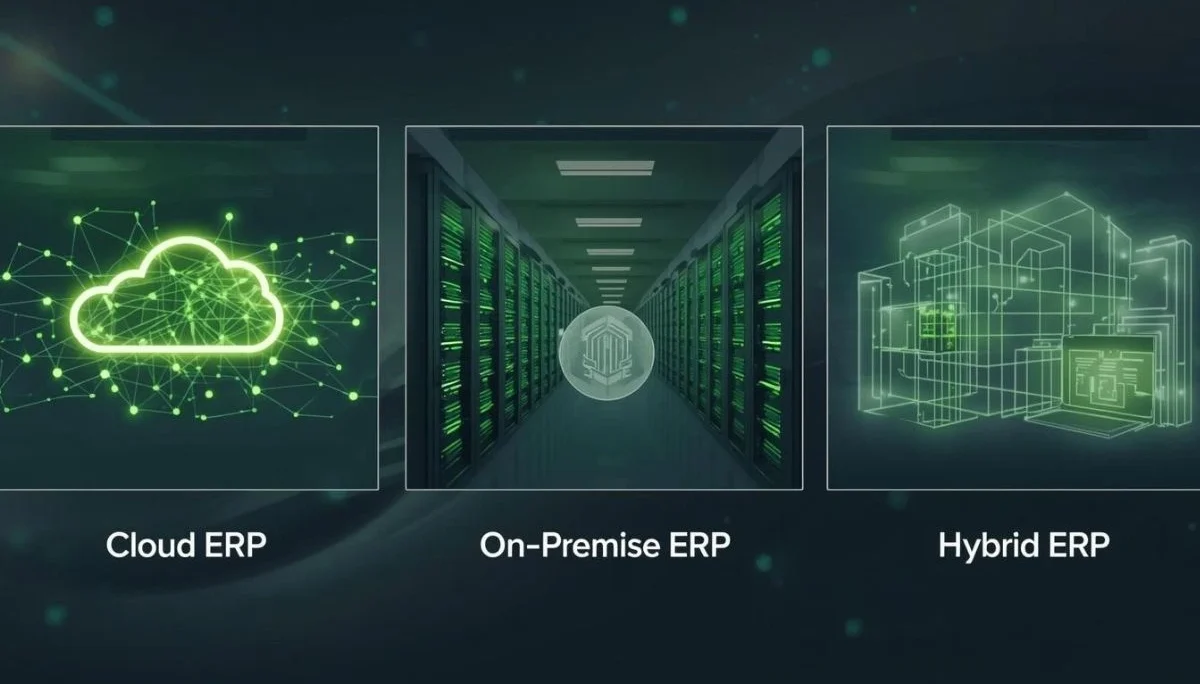
By 2025, an ERP (Enterprise Resource Planning) decision is no longer feature- or pricing-based but agile or data sovereign or governance or resilient or scalable to the future. The decision has strategic implications for organisations in the UK that are considering the cloud, hybrid, or on-premise ERP models. Here we discuss the trade-offs and give advice specific to the UK entrepreneurs.
The ERP Deployment Options: A summary in a nutshell.
- On-Premise ERP – Your ERP is on the premises of your data centre or private infrastructure and is managed by your IT.
- Cloud ERP: a vendor (or a public cloud system) hosts the ERP and offers it as a Software-as-a-Service (SaaS).
- Hybrid ERP – a mixture: certain modules or data stay on-premise (or in a private cloud), whereas others are running in the vendor’s or public cloud.
Both models come with specific benefits and limitations, along with risk profiles – and in the 2025 context, it is a bigger factor than ever before.
The Forces that are Shaping ERP Decisions in 2025.
It’s worth noting before delving into which model suits best that there are forces that are redefining the adoption of ERP:
- The use of clouds is almost universal: the proportion of organisations currently using some type of cloud service is 96 per cent. IT Desk
- 92 per cent of organisations run multi-cloud or hybrid deployments to balance cost, control, and resilience, making this approach the norm.
- The UK companies are particularly vulnerable to data sovereignty, regulatory compliance, and the increased costs of clouds. Others are moving out of a single cloud stack and using hybrid or multicloud approaches. TechRadar
- In regulated industries such as finance, health, and government, organisations store sensitive data on-prem or within private infrastructure.
- ERP systems in 2025 will likely integrate AI/ML, IoT, and real-time analytics while offering higher levels of automation.
Therefore, instead of a clean-cut, one-size-fits-all option, a staged or blended approach is being adopted by most UK organisations.
Comparison of the advantages and disadvantages of cloud, hybrid and on-premise.
Model Strengths/Weaknesses/Challenges.
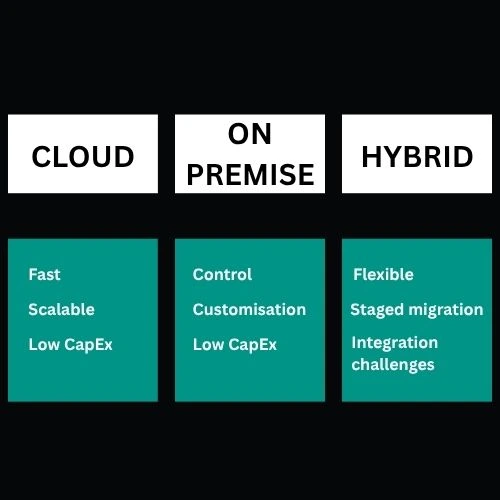
Cloud ERP Reduced initial capital investment (CapEx) → transfers ERP to an operating expense (OpEx). Quicker deployment, automatic updates, high baseline security, effortless remote access, scalability. evolutionmanagedservices.co.uk+2NetSuite+2.
Reduced command over infrastructure, possible vendor lock-in, difficulty in profound customisation, cloud cost overruns, issue of data residency / sovereignty
On-Premise ERP Optimum control (security, data, operations), full customisation, direct connectivity with legacy on-site systems, predictable internal cost, increased maintenance, slower updates, increased burden on internal IT personnel, and reduced flexibility for remote/distributed working.
Hybrid ERP A compromise between the best and the best: the modules that can be transferred to the cloud are moved there; the most sensitive functionality and data remain on-prem. It is flexible and can be migrated in stages. Integration complexity and difficulty in single governance may exist between modules in clouds and on-prem security bridging issues.
An example of a useful analogy: a cloud is the high-speed interstate, on-premise is the private road that you own, and hybrid is combining the two to navigate through your terrain.
What UK companies need to pay attention to.
1. Regulatory & Compliance Requirements.
The UK and EU laws (e.g., GDPR) introduce stringent requirements on where data regarding personal information is stored and processed. Sensitive groups of data, such as financial services or health, may prefer hybrid or on-premise placements within industries,tries, such as financial services or health.
2. Vendor Risk/Data Sovereignty.
The dependence on one cloud provider may subject firms to geopolitical, legal or vendor risk. The hybrid or multi-cloud approach is becoming a trend among British companies in order to retain control and prevent overdependence. TechRadar
3. Current IT Investments as well as Legacy Systems.
A hybrid or gradual approach can secure an investment made by a company that already possesses a wide range of on-premise infrastructure (ERP, databases, manufacturing systems). It can be too risky or too expensive to transfer everything to the cloud overnight.
4. Cost & Cash Flow Strategy
Cloud transfers the costs of capital investment to the recurring subscriptions. That will facilitate the budgeting and scaling where necessary. Watch, however, for cloud waste and unexpected spikes of usage.
5. Flexibility, Scalability and Innovation.
In case your strategy includes expansion, new markets, M&A, remote teams or sophisticated analytics, agility is supported with the help of cloud systems or hybrid systems. On-prem architecture is rather limiting to such expansion.
6. Internal Skills & Operations
Does your IT department have the knowledge to deal with infrastructure, patches, security and backup? Otherwise, a cloud- or hybrid vendor-based model decreases the load.
7. Integration & Performance
Latency, API connectivity, and transaction volumes must be taken into consideration in hybrid designs – a poorly designed system may be fragmented or cause performance bottlenecks.
A Question of What UK Companies Should Select in 2025?
There’s no silver bullet. However, here is the playbook style adapted to the profiles of typical companies in the UK:
- Small and medium enterprises SMEs that do not have a heavy regulatory load.
- It is usually good to lean to Cloud ERP. Cloud is seaward due to its fast time to value, reduced capital requirements and low IT overheads.
- Larger businesses, controlled industry or already existing on-prem.
- The sweet spot is usually hybrid ERP. Keep core, sensitive or custom modules on-premise and migrate standard modules (HR, CRM, analytics) to the cloud. As confidence and architecture mature, more can shift as time progresses.
Extremely controlled, security-sensitive or critical applications.
Organisations can still use on-premise ERP (or private cloud) for specific cases or the entire stack when they require greater control, auditability, and performance determinism.
More simply put: begin by setting your risk-taking, compliance position, innovation strategy, and current investments – and then select a deployment path that fits, rather than one dictated by fashion.
A Migration Mindset — Do not think “All or Nothing”.
Although you might start with on-premise or hybrid, you must build your architecture in a manner that is migration-friendly:
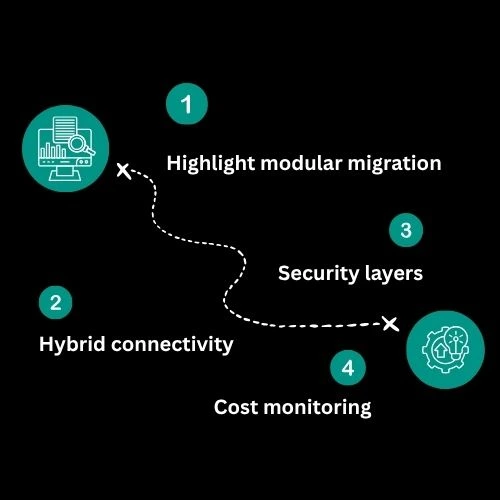
- Select ERP solutions built on modular migration, APIs, data portability, and hybrid connectivity.
- Adopt integration layers and middleware to enable seamless communication between on-premise and cloud modules.
- Track usage and cost data to identify inefficiencies or overspending in your cloud components.
- Implement a zero-trust and unified security model across both on-premise and cloud environments.
Balancing the consistency of global operations with the local responsiveness, many companies implement a two-level solution: implementing central ERP in the cloud and regional or special modules in local infrastructure. NetSuite
Final Thoughts
In the case of the UK companies of 2025, the decision to go cloud-based, hybrid or on-premise based on ERP is not so much a question of technology dogma but more a question of what model best fits your business DNA, risk interest and direction of growth. Although cloud ERP is on the rise and a default in most cases, the hybrid provides a feasible compromise to organisations that have legal, legacy, or regulatory limitations. In the meantime, businesses still use on-premise systems in edge cases where they cannot compromise on control and performance requirements.
You can also have a map of major ERP vendors and models in the UK (e.g., Microsoft, SAP, and Oracle) by mode of deployment, should you wish to have one, and a decision matrix that you will use internally. Would you like me to add that?